12Sep 2024
Parmigiano Reggiano: A Journey through Tradition, Mastery, and Uniqueness
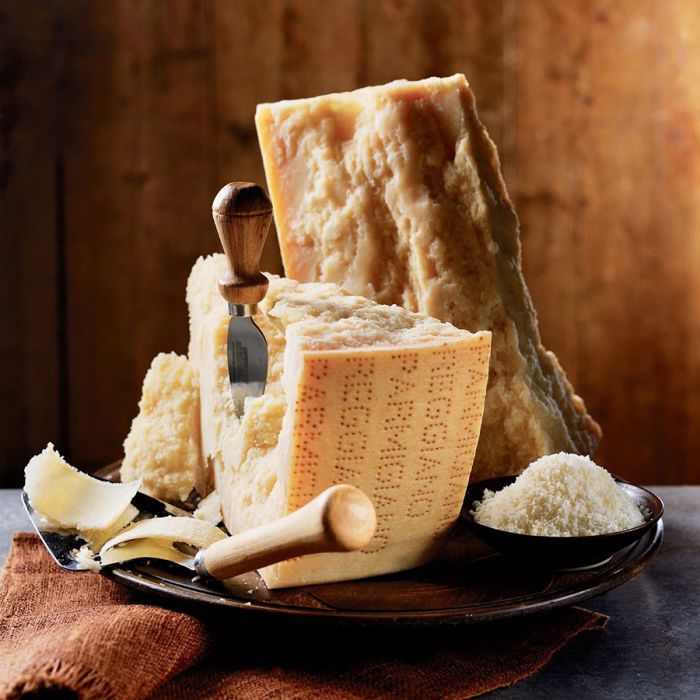
Parmigiano Reggiano: The King of Cheeses and the Secrets of its Excellence
Parmigiano Reggiano is an Italian hard cheese, renowned for its rich and complex flavor. The name evokes its place of origin: "Parmigiano" indicates it comes from the Parma area, while "Reggiano" denotes its production in the Reggio Emilia area.
Although the production area has expanded to include parts of Modena, Mantua, and Bologna provinces, Parmigiano Reggiano has retained its traditional characteristics, respecting ancient production techniques and traditional cattle breeding areas.
Parmigiano Reggiano is unparalleled, made using only three ingredients: milk, rennet, and salt.
Production of Parmigiano Reggiano
The production of Parmigiano Reggiano is strictly controlled, following traditional methods passed down through centuries. It is a Protected Designation of Origin (PDO) product, with a production specification ensuring its quality. Each wheel of Parmigiano Reggiano must have various marks including the dairy code, month and year of production, and a unique identification code.
Today, most Parmigiano Reggiano is made using milk from Friesian cows introduced to the area during the 20th century. However, in the past, the traditional breed for cheese production was the Rossa Reggiana. Due to lower milk productivity, the Reggiana breed has been gradually abandoned, but some small dairies still use its milk to produce a superior quality cheese, grouped under the National Association of Reggiana Breed Cattle Breeders.
In our selection, you can find Parmigiano Reggiano Vacche Rosse, including the including the sole organically certified product approved and certified by Demeter. A true delicacy!
The role of the cheesemaker, or master cheesemaker, is crucial in dairy farms producing Parmigiano Reggiano. The master cheesemaker oversees all stages of cheese transformation with care and skill. Within the dairy, they coordinate work teams in different production areas, applying deep knowledge of hygiene, food safety, fermentation, cheesemaking, salting, and cheese aging. Through their efforts, the cheesemaker helps preserve the craftsmanship and authenticity of Parmigiano Reggiano. Thanks to their manual dexterity, expertise, experience, and passion, each wheel of Parmigiano Reggiano produced in every dairy is unique and distinctive.
Characteristics
A wheel of Parmigiano Reggiano must weigh between 30 kg and 40 kg. Aging is a fundamental process in which the cheese develops a granular and compact texture, lasting a minimum of 12 months during which biochemical and physical transformations occur in the milk. During this period, Parmigiano develops its distinctive characteristics, with its flavor intensifying over time, ranging from 24 to 36 months of aging. However, wheels aged for even longer periods, such as 48 or even 72 months, can be found at prestigious gastronomic events and specialized shops offering tasting sessions. Parmigiano Reggiano is produced for 20% in mountain areas.
Parmigiano Reggiano (PDO) vs Grana Padano (PDO)
It is essential to appreciate and understand the distinctive characteristics of these two cheeses to fully maximize their use in the kitchen.
At first glance, the two cheeses appear similar in shape, size, and other sensory characteristics. Besides being lactose-free, their nutritional values, such as proteins, calcium, phosphorus, and potassium, are similar.
However, there are significant differences despite the similar technical processes used in the milk processing for both cheeses.
Firstly, the production area of Grana Padano is larger than that of Parmigiano Reggiano and includes various provinces in Lombardy, Piedmont, Trentino-Alto Adige, Emilia-Romagna, and Veneto.
Another fundamental difference concerns the feeding of the cattle. Cows destined for Parmigiano Reggiano production must be exclusively fed with hay and grass from the same production area as the cheese. This also applies during production, where the cheese must be made without the addition of additives or preservatives. Cattle destined for Grana Padano production have a less restrictive diet, and the use of certain substances to prevent bacterial proliferation in the feed is involved.
Parmigiano Reggiano has a minimum aging time of 12 months and is consumed around 24 months, but it can achieve long aging, while Grana Padano has a minimum aging time of 8 months and is consumed around 15 months.
Unlike Parmigiano Reggiano, which uses a blend of whole milk and partially skimmed milk, Grana Padano is produced exclusively with skimmed milk. This difference gives Grana Padano a slightly lower fat content than Parmigiano Reggiano, and the shorter aging period affects the final flavor, which is more delicate.
The aging duration also influences the granularity of the cheese, which tends to be more pronounced in Parmigiano Reggiano than in Grana Padano.
Use of Parmigiano Reggiano
Parmigiano Reggiano can be enjoyed in flakes or grated and is a versatile ingredient in the kitchen, used to enrich many dishes, from pasta to risottos, from salads to soups. The more mature cheese can also be used on a cheese board, combined with a good Balsamic Vinegar, or with a nutty liquor which enhances its taste.
It does not contain lactose and is one of the few cheeses allowed for those who decide to go on a diet. In fact, in 100 grams of Parmigiano Reggiano, there are about 28 grams of fat. Most of these fats are not harmful; they are considered good, metabolized by our bodies, and used by the liver and muscles.
Parmigiano Reggiano is much more than just cheese: it is a symbol of Italian tradition and craftsmanship.